Washington and Lee leads the ODAC in points per game behind its prolific three-point shooting.
By Jack Hunter
Feb. 17, 2022
LEXINGTON — In Washington and Lee’s 81-67 win over Eastern Mennonite on Tuesday night, the Generals attempted 58 shots. In typical fashion for W&L, only two of them were mid-range shots. The other 56 all came from either behind the three-point line or within four feet of the basket, according to the game’s live shot chart.
“We’d rather just take a three than a contested mid-range shot off the dribble,” said sophomore forward Robert DiSibio, who is fourth in the Old Dominion Athletic Conference in scoring. “A lot of us are capable of hitting that, but we do always talk about giving up a good shot to get a great one. We might pass up an open one-dribble, pull-up mid range jumper to kick it out for an open three.”
Six of the ODAC’s 11 other teams have been either ranked or received votes to be ranked in the D3hoops.com top 25 poll this season, including the current, unanimous No.1-ranked Randolph-Macon Yellow Jackets. Six teams have fifth-year players and nine teams have at least one player taller than 6’6″, or W&L’s tallest player.
In one of Division III’s toughest conferences, W&L (11-10, 9-6 ODAC) has used the three-point shot to thrive offensively against taller and much older teams.
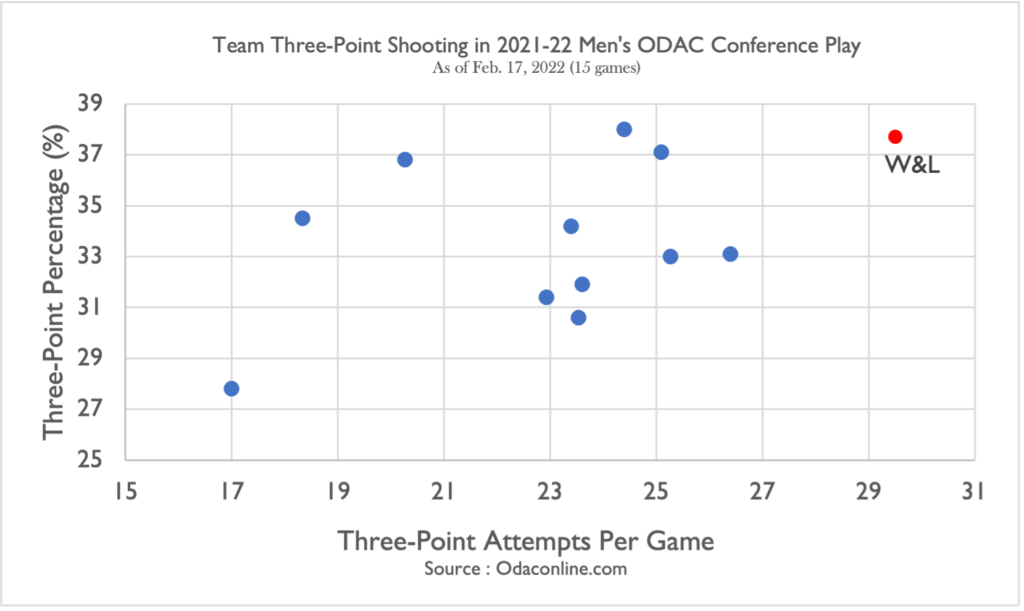
W&L has attempted 29.5 three-pointers a game in conference play, which is three more per game than second-place Ferrum and six over the conference average. Despite W&L’s volume, they have shot almost 38% from three-point range and are within half a percent of first-place Randolph College, who only takes 24.5 attempts per game.
Because of W&L’s efficient three-point shooting with a high volume of shots, the Generals are tied for sixth in the country in three-point field goals made per game. But Head Coach Chris McHugh said W&L’s approach isn’t as mathematical as it seems.
“We don’t want to say that we have to shoot or make a certain number,” McHugh said. “What we talk about is generating great shots. Open rhythm threes are great shots for us, especially if you’re a guy where that’s a strength of yours.”
W&L has four shooters who are shooting over 40% from three-point range, including two frontcourt starters: DiSibio and sophomore forward Jack d’Entremont.
“I think what Rob [DiSibio], Gus [Wise] and I bring to the table is pretty unique for this level, being able to spread the floor and shoot it at 6’5″ and 6’6″,” d’Entremont said. “It puts defenses in tough spots.”
McHugh said a big part of the offense’s success has come from DiSibio and D’Entremont being able to spread the floor.
“If teams have certain bigger guys, we’re going to challenge you to see if you can guard all over the floor,” McHugh said. “”We try to setup mismatches offensively where you have to guard big, skilled guys in space.”
d’Entremont said W&L gets its best looks from three-point range when they can drive the ball to the basket.
“I think a big focus for teams that scout is trying to keep us out of the paint,” d’Entremont said. “So when teams execute their gameplan and make it tough for us to get in the paint, it just leads to more open looks.”
At a glance, it doesn’t make much sense why teams would pack the paint against W&L, who shoot the most three-pointers and the least two-pointers per game inside the conference. But W&L’s efficiency from two-point range has forced teams to respect the Generals around the basket.
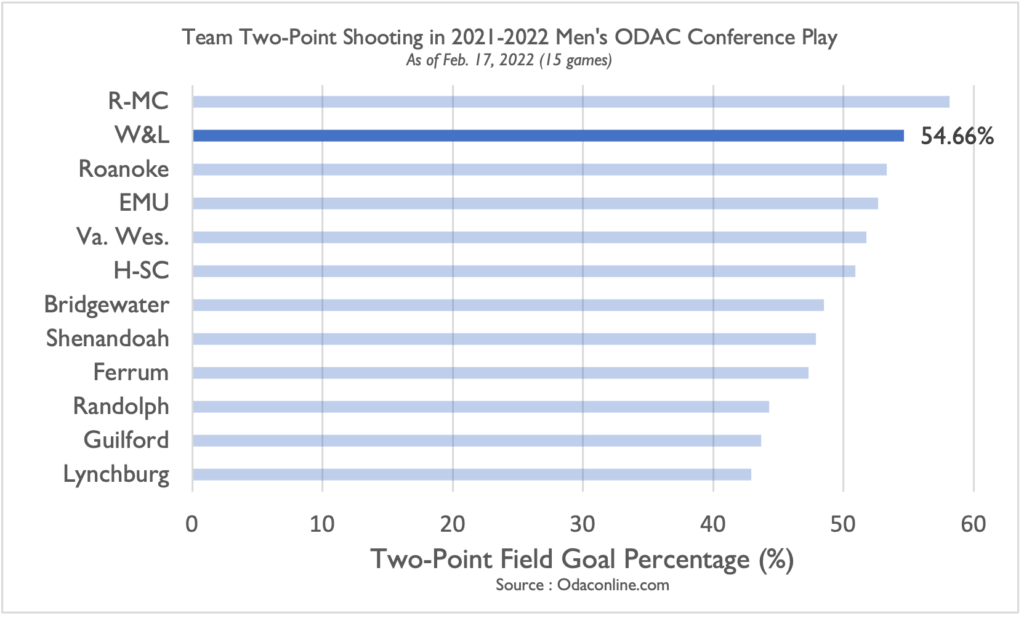
W&L only trails the nation’s top team, Randolph-Macon, in two-point field goal percentage inside of the conference. DiSibio said the high percentage comes from intentional shot selection.
“One of our strengths as a team is three-point shooting,” DiSibio said. “But coach will also emphasize getting to the rim or kicking it out for an open three. We shoot a lot of threes, we get to the rim a good amount, but we don’t really shoot long two’s or low percentage shots like that.”
In W&L’s win over EMU on Tuesday night, the Generals shot 33 times inside of the restricted area, according to the live shot chart. The restricted area sits four feet from the basket. They converted on 19, or almost 56%, of their attempts.
Going forward into the ODAC tournament next week, d’Entremont said it’ll be crucial to establish a presence in the paint to setup the team’s shooters.
“When we’re at our best is when we’re moving the ball, getting paint touches, getting two feet in the paint, and then finding our shooters on the outside when the defense has to collapse,” d’Entremont said.
Be First to Comment